
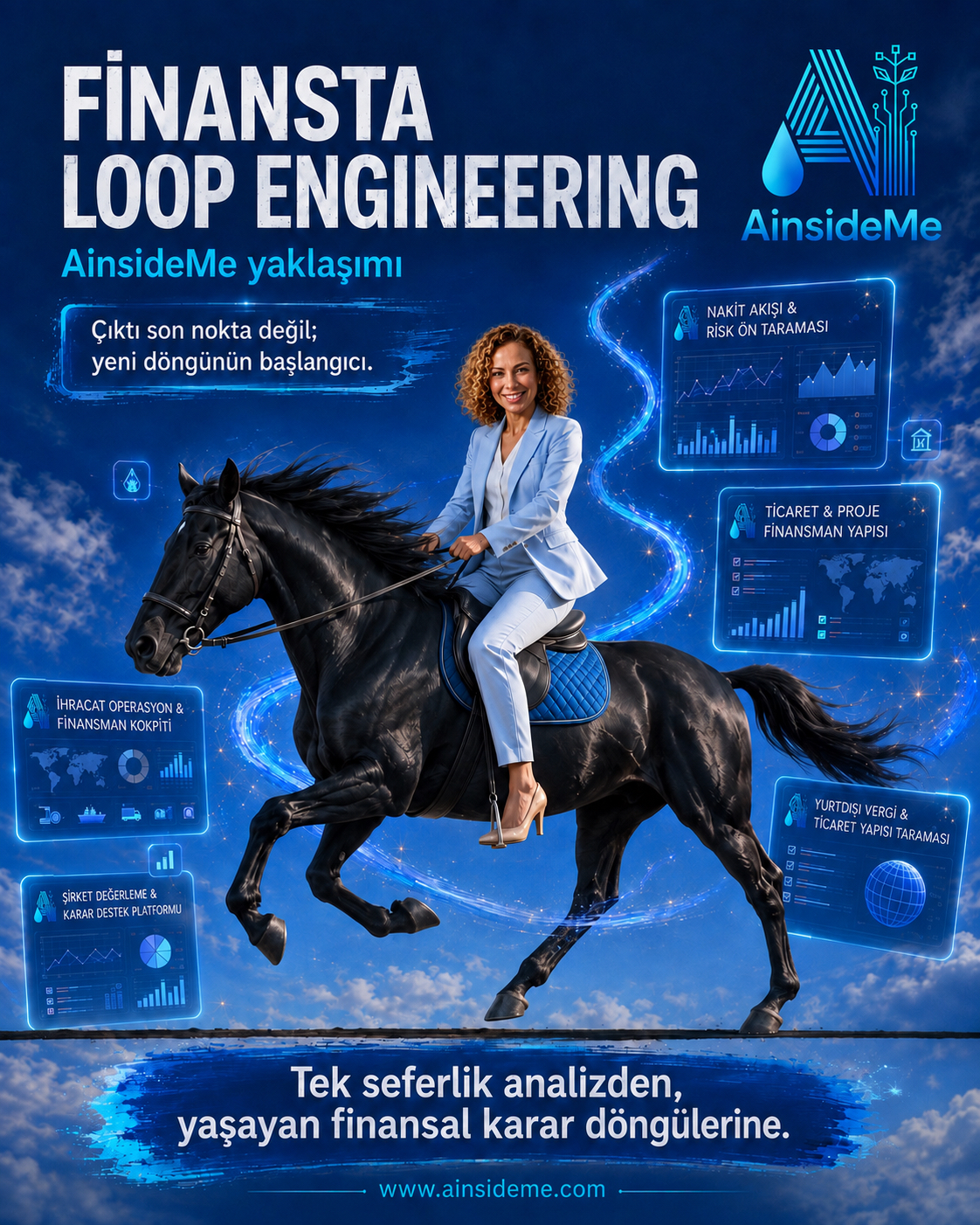
A Financial Model’s Job Does Not End with a Result

Updated: 1 day ago
One concept attracting increasing attention in AI is Loop Engineering.
Its essence is simple: a system does not merely complete a task and stop. Its output returns to the process alongside changing data and new conditions. The system reassesses, updates scenarios when needed, and moves into the next decision cycle.
In other words, the output is not the endpoint; it is the beginning of a new cycle.
For finance, this is a surprisingly natural approach. Companies’ financial realities do not move in straight lines.
A forecast is made, then actual results arrive. Collections are delayed. Exchange rates change. Project costs rise. Financing conditions shift. A customer’s risk increases. A new investment decision is made.
A financial model’s quality therefore cannot be measured only by the accuracy of its first calculation. What it does when new reality arrives matters too.
Looking at Ainsideme’s digital applications this way reveals something interesting: Loop Engineering is not an unfamiliar technology idea to add later. Much of the applications’ logic already works this way.
Cash Flow & Risk Preliminary Screening is a clear example. The model does more than produce a twelve-month cash forecast. It uses a weekly view for the first month and monthly views thereafter, tracks forecast-versus-actual variances, and reassesses breakpoints, DSCR, maturities, currency effects, and stress scenarios within the same financial structure.
Cash flow is therefore not merely a report; it is a forecast → actuals → variance → reassessment cycle.
Trade & Project Finance Structure applies the same thinking differently. The project’s trade structure, ECA coverage, development banks, DFI funding, consortium possibilities, and equity needs are assessed together. When project conditions change, the financing structure must be tested again, because a structure that worked on day one may produce different results after costs or scope change.
International Tax & Trade Structure Screening examines country, holding-company, trade, and service flows together. Changes in transaction structure change tax effects. Its value lies not in naming the right structure once, but in asking the question again as the company changes.
Export Operations & Financing Cockpit is a more dynamic version of this cycle. Market and payment method, letters of credit, financing, currency risk, credit insurance, sanctions screening, and cash effects are parts of one transaction. A change in one affects the others. The cockpit therefore does more than track export transactions; it rereads the economic outcome as conditions change.
The final link is the Company Valuation and Decision Support Platform.
Here too, value is not a one-time number. It changes as the company’s business model, financial structure, valuation profile, growth assumptions, cost of capital, risks, and scenarios evolve. A SaaS company and a project-based EPC company create value differently, so the model does not treat them identically.
From this perspective, the meaningful question is no longer only:
‘What is the company worth?’
It goes further:
‘What changed since yesterday, and why did that change affect value?’
This is where Loop Engineering and Ainsideme intersect.
Cash flow, financing, foreign trade, tax risk, or valuation: each application addresses a different financial problem, but their operating principles are similar:
Observe the data. Assess the conditions. Run the scenario. Track the change. Reassess.
The Virtual CFO service provides the human side of this cycle.
A model can show a change, but not every change requires action. A financing option can be cheaper without being better for the company. A tax advantage can look attractive mathematically while conflicting with the commercial structure. A valuation can rise on an assumption that is not sustainable.
Technology runs the cycle. Financial judgment determines where the cycle becomes a decision.
That is why we see Ainsideme’s digital applications not as one-off analytical tools, but as financial decision structures that run again as the company changes.
Perhaps the financial meaning of Loop Engineering is no more complicated than this:
If the company changes, its financial model should not stand still.
From one-off analysis to living financial decision cycles.


Comments